🔥CORRECT SQUAT BAR PATH 👇

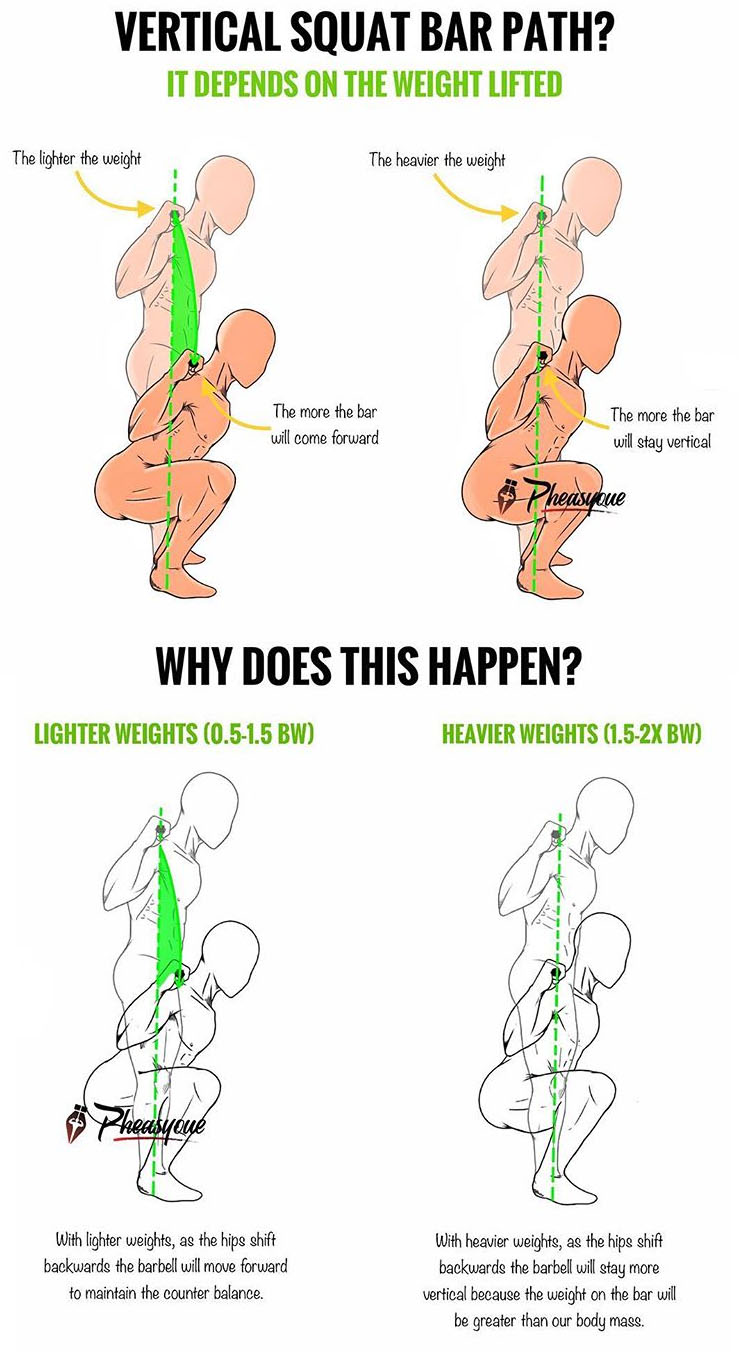
💪 A lot of people have the idea that if you don’t have a perfectly vertical bar path, your squat is inefficient. They treat it as an immutable law of good squatting.
✅ However, this simply isn’t true. With very heavy loads (2x your bodyweight or more) your bar path should be very close to vertical, but you shouldn’t expect it to be with lighter loads. Why?
[wp_ad_camp_2]
🚨 The simple answer is this: your ass isn’t weightless.
✅ If you assume that the barbell itself is the center of mass of the system, then yes, you should expect the bar path to be pretty darn vertical, with the bar always staying over the middle of your foot.
✅ However, the barbell itself is not the center of mass of the system. You can’t discount the mass of your body segments. Almost all of your torso will be behind mid-foot, and most of your femur will be behind mid-foot, while your arms will be roughly over mid-foot, and most of your lower legs will be mostly over or slightly in front of mid-foot. Taking all of those segments into account, the center of mass for your body will almost certainly be behind mid-foot for most of the lift.
[wp_ad_camp_4]

Essentially bar path depends on the weight of the bar compared to the weight of your body. If you’re 200lbs and you’re squatting 200lbs, and you want the center of pressure to remain over mid-foot, then the bar is going to need to shift forward to the same degree as the center of mass of your body shifts back. If you’re 200lbs and you’re squatting 600lbs, then the bar will only need to shift forward 1/3 as far as the center of mass of your body shifts back (and at that point, the bar path will basically be vertical).
[wp_ad_camp_5]
Yes, you want the center of pressure to stay over the middle of your foot.
Yes, you want the center of mass for the system to stay over the middle of your foot.
No, you shouldn’t expect the bar to stay over the middle of your foot and move in a perfectly vertical line unless you’re squatting a ton of weight.